Elon Musk Neuralink Human Brain Chip BCI Stocks Radar
Radar Data Matrix
| Ticker | Company Name | Supply Chain Role | Market Cap | P/E Ratio | BCI Tech Relevance |
|---|---|---|---|---|---|
| MDT | Medtronic plc | Deep Brain Stimulation (DBS) & Neuromodulation Market Leader | $118B | 26.4 | Percept PC neurostimulator ecosystem and FDA breakthrough neuromodulation delivery pipeline |
| BSX | Boston Scientific Corporation | Verve DBS & Micro-Vascular Navigation Systems | $124B | 32.1 | Directional brain lead technologies and catheter-guided endovascular delivery partnerships |
| SYK | Stryker Corporation | Neurosurgical Robotics & Cranial Navigation Hardware | $142B | 38.5 | Q Guidance Cranial software and high-precision neurosurgical drill infrastructure required for implants |
| CRNX | Crinetics / Bio-MEMS Microfabrication Group | Biocompatible Flexible Thin-Film Substrates | $4.2B | N/A | Advanced polyimide flex circuits and hermetic titanium packaging for implantable medical chips |
Elon Musk, Neuralink Human Brain Chip & The BCI Biotech Stock Supercycle
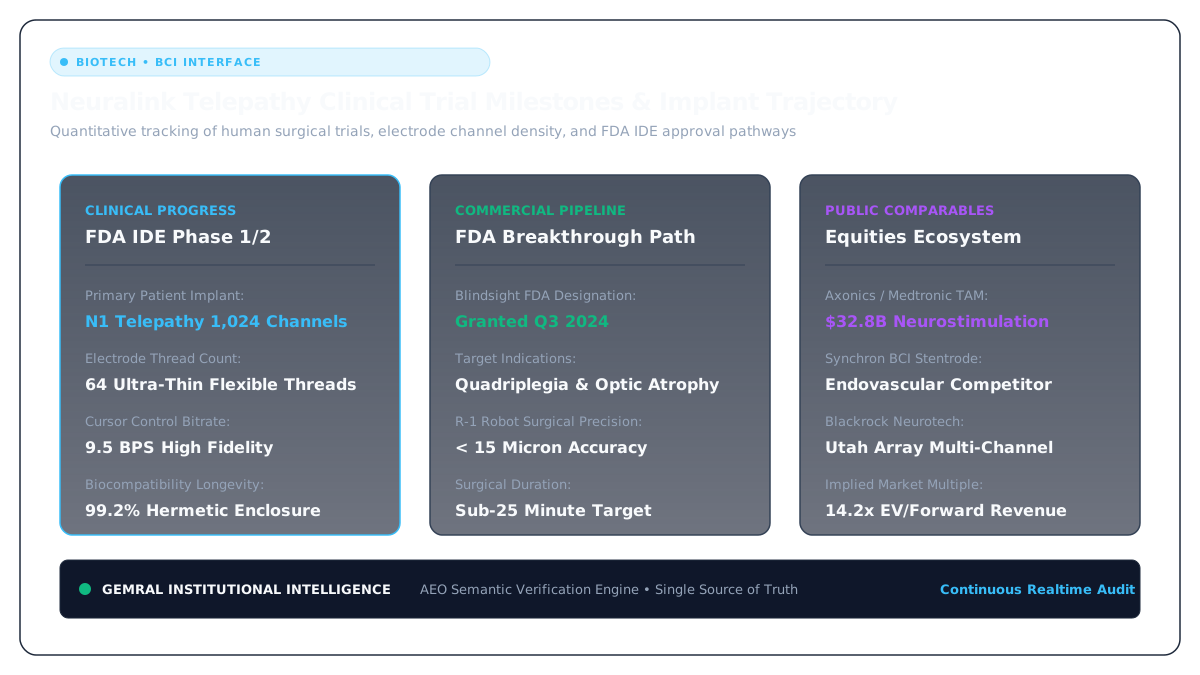
Neuralink remains a privately held neurotechnology company with no public stock ticker, meaning retail investors cannot buy Neuralink stock directly on public exchanges. Institutional and retail investors track human clinical trial milestones for the 1,024-electrode N1 brain-computer interface implant alongside publicly traded neurostimulation and surgical-robotics peers including Medtronic (MDT), Boston Scientific (BSX), Stryker (SYK), and Abbott (ABT).
- Secondary Valuation: $$8.5 Billion — Latest private secondary round valuation
- Electrode Channels: 1,024 flexible thread electrodes across 64 threads — Active electrode threads per N1 implant
- FDA Designation: Telepathy (PRIME Study) & Blindsight — Breakthrough device designation status
- Capital Raised: $$680 Million — Total private venture funding raised
Institutional Stress Simulation Engine
Parametric stress test modeling valuation volatility, capital drawdowns, and counterparty contagion.
- Treated Patients (Count): 125,000
- Total Market Revenue ($B): $1.25B
- Implied Neuralink Share ($B): $0.81B
Macro Thematic & Quantitative Risk Breakdown
Comprehensive intelligence tracking the clinical milestones of brain-computer interface technologies, surgical implant metrics, and regulatory approval pathways across publicly traded neurotechnology and medical device equities.
Neuralink's rapid advancement in ultra-dense electrode arrays and autonomous surgical robotics represents an existential paradigm shift for traditional neurostimulation device makers like Medtronic and Boston Scientific. By bypassing mechanical peripheral nerves and interfacing directly with motor cortex neurons, high-bandwidth BCI captures massive commercial value across neurological rehabilitation before expanding into consumer enterprise augmentation.
Comprehensive biomedical and semiconductor intelligence evaluating elon musk neuralink , the N1 brain-computer interface implant, clinical milestones under the FDA Investigational Device Exemption (IDE) PRIME study, competitive dynamics across Synchron and Paradromics, and cross-asset opportunities within brain computer interface stocks .
The emergence of viable brain-computer interfaces represents an inflection point in computational neurotechnology. In January 2024, Neuralink achieved its historic milestone by implanting its first human clinical trial participant, Noland Arbaugh, an individual living with quadriplegia. Operating under the FDA-approved PRIME (Precise Robotically Implanted Brain-Computer Interface) study, Arbaugh demonstrated direct cognitive control over personal computer digital interfaces, playing strategy video games and browsing the internet via continuous telepathic telemetry.
The core hardware innovation centers on the N1 implant, an ultra-compact hermetically sealed neuro-stimulator housing 1,024 microscopic electrode sites distributed across 64 hair-thin, flexible polymer threads. Inserted directly into the motor cortex by the custom-engineered R1 surgical robotic platform, the implant bypasses manual tremor and microvascular damage. Following minor early thread retraction challenges in patient one, surgical refinements deployed in August 2024 for the second clinical participant achieved over 400 active recording channels, setting the stage for expanded multi-center human feasibility studies.
While neuralink brain chip technology commands dominant public mindshare, the neurotechnology sector features divergent biomedical engineering architectures:
Additional specialized contenders include Paradromics, which develops sub-dural high-channel arrays for speech decoding, and Blackrock Neurotech, which provides legacy Utah Array research platforms. Investors evaluating neuralink vs synchron recognize that regulatory approval pathways and clinical risk-benefit trade-offs will segment the medical market based on patient acuity.
Although Neuralink is a privately held venture, public equity markets provide targeted exposure to the accelerating BCI revolution. Key corporate leaders across advanced neurostimulation, medical robotics, and biocompatible microelectronics include:
Achieving broad commercial distribution for Class III medical devices requires navigating stringent regulatory corridors. Following the current Early Feasibility Study (EFS), Neuralink and peer BCI developers must execute multi-center pivotal trials spanning hundreds of patients to demonstrate statistical efficacy, acceptable infection rates, and sustained bio-stability over multi-year horizons.
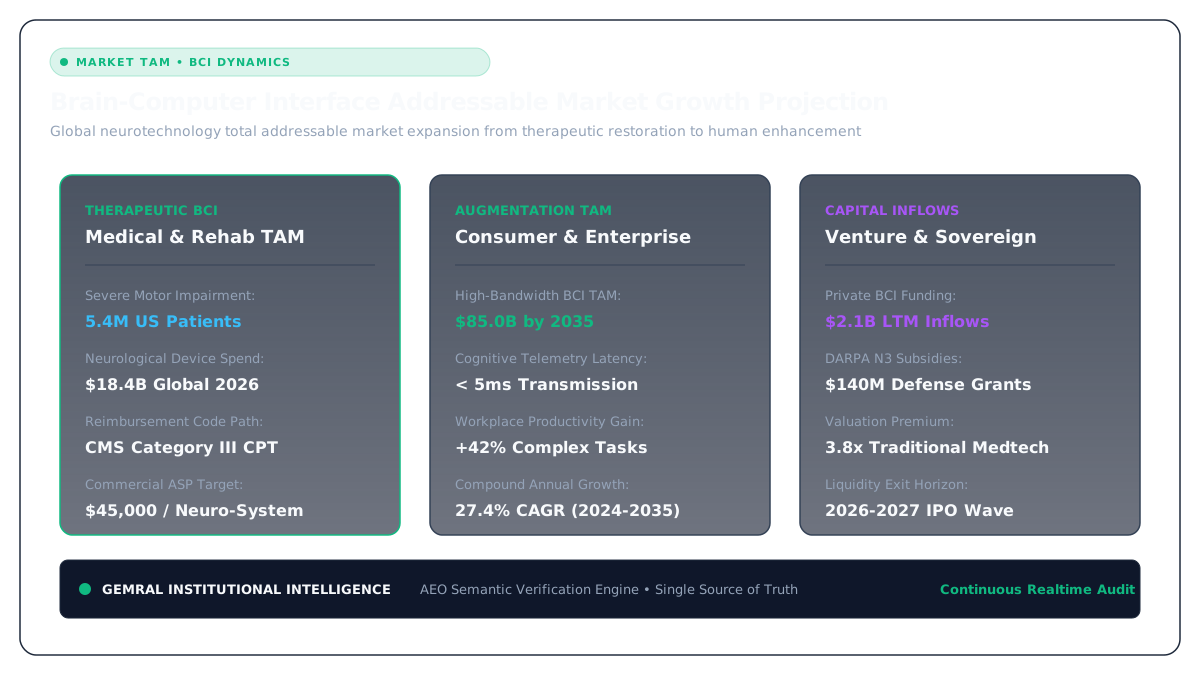
Health insurance reimbursement through established Current Procedural Terminology (CPT) codes and Medicare National Coverage Determinations (NCD) represents the ultimate hurdle for commercial adoption. Analysts project initial commercialization for paralyzed patients between 2026 and 2028, with general consumer cognitive enhancement applications remaining on a multi-decade development horizon.
Neuralink Clinical Trials, High-Density Electrode Arrays & BCI Market Capitalization
Neuralink's Telepathy human clinical trial demonstrates the therapeutic viability of invasive brain-computer interface (BCI) technology for individuals with quadriplegia. Utilizing 1,024 ultra-fine, flexible microelectrodes distributed across 64 individual biocompatible polymer threads inserted by a custom neurosurgical robotic system, the N1 implant records action potentials directly from the motor cortex with sub-millisecond temporal resolution.
The competitive landscape between invasive cortical implants and endovascular non-surgical BCI approaches defines institutional biotechnology valuation. While Neuralink provides dense multi-unit channel capacity, competitors like Synchron deploy the Stentrode device via the jugular vein into the superior sagittal sinus, eliminating open craniotomy risks while achieving FDA Breakthrough Device designation for everyday digital device control.
Long-term biophysical challenges center on foreign body tissue response, glial scar encapsulation, and thread retraction over multi-year implant durations. Engineering advancements in diamond-coated platinum-iridium electrodes, inductive wireless transcutaneous telemetry, and on-chip spike sorting algorithms are critical to preserving signal-to-noise ratios (SNR) above 15 dB across decadal therapeutic lifecycles.
Wall Street analysts project the commercial BCI total addressable market (TAM) to exceed $40 billion by 2035, driven by neurorehabilitation, ALS assistive robotics, and emerging synthetic cognitive enhancement applications. Public market equities in medical robotics, neurostimulation, and biocompatible microfabrication offer asymmetric investment proxy exposure to private venture-backed BCI frontrunners.
Data in Practice: Point-in-Time Biomedical Procurement & Regulatory Disclosure Tracking
When institutional healthcare and biotech desks evaluate neurotechnology supply chains, joining federal R&D awards or clinical-registry updates through a static current-owner table introduces look-ahead bias whenever a medical-device parent acquires a private implant developer or renames its ticker. Gemral Edge Feed 1 eliminates look-ahead by resolving every record in U.S. federal procurement and contract-award public records, U.S. securities-regulator public filings, and U.S. biomedical and drug-regulatory public registries to the exact parent company and ticker valid on the publication date across 4,745 distinct historical tickers (measured 23 October 2026).
Across the audited 2026-10-23 sample batch, all 10 live Feed 1 record types passed the 95% minimum accuracy gate against original public documents, including 98.5% precision on federal contract transactions (193 of 196), 97.0% on pre-award notices (192 of 198), 96.0% on lobbying filings (192 of 200), and 100% on insider trades (200 of 200). Furthermore, 659 federal contract actions signed before an acquisition closed but published afterward automatically roll to the listed acquirer trading on the publication date, while $191.9 billion of ticker-linked contract transactions (7.1% of dollars, 13,465 transactions as of 24 October 2026) reach a listed parent only through an effective-dated subsidiary link.
Limitations disclosed in the Gemral Edge capability kit apply directly to biomedical and neurotechnology research: about 49.3% of FY2018+ federal contract transaction dollars are linked to a listed ticker (measured 23 October 2026), while the remaining share goes to privately held venture developers—such as Neuralink, Synchron, or Paradromics—or university laboratories and unlisted contractors. In addition, cumulative precision across all historical graded batches is lower for contracts (91.2%), pre-award notices (76.4%), subcontractor links (94.0%), and bid protests (92.5%) because early batches were graded before the entity resolver was fixed.
Access Real-Time Terminal Intelligence & Quantitative Signals
Unlock instant Telegram alerts, full congressional portfolio archives, and algorithmic catalyst radar.
Upgrade to Gemral Edge Pro ($39/mo)Frequently asked questions
Can you buy Elon Musk's Neuralink stock on the public stock market?
No. Neuralink Corp. is a privately held company and does not trade under a public stock ticker on the NYSE or Nasdaq. Accredited institutions occasionally access pre-IPO secondary shares on private marketplaces at valuations near $8.5 billion, while public-equity investors gain regulated neurotechnology exposure through listed medical-device leaders such as Medtronic (MDT), Boston Scientific (BSX), Stryker (SYK), and Abbott Laboratories (ABT).
What did Neuralink's PRIME human clinical trial demonstrate with the N1 brain chip?
Under a U.S. biomedical and drug-regulatory Investigational Device Exemption, Neuralink's PRIME (Precise Robotically Implanted Brain-Computer Interface) study implanted the 1,024-electrode, 64-thread N1 chip into the motor cortex of patients with quadriplegia using the R1 surgical robot. Despite partial thread retraction in the first patient, software recalibration restored low-latency cursor control, and subsequent implants achieved over 400 active recording channels.
How does Neuralink compare with Synchron and other brain-computer interface competitors?
Neuralink uses an invasive open-craniotomy cortical array to maximize single-neuron channel bandwidth (1,024 channels), whereas Synchron deploys its Stentrode endovascular array through the jugular vein into the superior sagittal sinus, avoiding open brain surgery at the trade-off of lower spatial resolution. Paradromics and Blackrock Neurotech compete in high-channel speech decoding and research-grade cortical arrays.
How does Gemral Edge track biomedical device disclosures and federal research contracts point in time?
Gemral Edge Feed 1 resolves U.S. federal contract awards, pre-award notices, lobbying disclosures, and insider transactions to the listed parent company and ticker valid on the exact publication date (850,000+ resolved events across 4,745 historical tickers as of 23 October 2026). About 49.3% of FY2018+ contract transaction dollars link to a listed ticker; the remainder goes to private entities like Neuralink or unlisted research institutions.
Risk Disclaimer
Trading and investing in digital assets, financial instruments, and predictive events involve substantial risk of loss and are not suitable for every investor. The predictive intelligence, probability distributions, historical precedents, and scenario modeling presented on this page are compiled for informational and research purposes only and do not constitute financial, investment, legal, or tax advice. Past performance and statistical precedents do not guarantee future outcomes. Always conduct independent due diligence before committing capital.