US HBM Chip Ban, Huawei Ascend 910C & SMIC Chip Radar
Radar Data Matrix
| Ticker | Company Name | Strategic Industry Role | Market Cap | P/E Ratio | Geopolitical Catalyst |
|---|---|---|---|---|---|
| SMIC (0981.HK) | Semiconductor Manufacturing International Corp | China Flagship Foundry (Advanced DUV Multi-Patterning) | $38B | 34.2 | State-subsidized expansion of 7nm/5nm equivalents for Huawei Ascend and Kirin silicon |
| ASML | ASML Holding N.V. | Monopoly Photolithography Equipment (EUV & Immersion DUV) | $310B | 41.5 | Netherlands and US export license restrictions curtailing Twinscan NXT:1980i maintenance |
| 000660.KS | SK Hynix Inc. | HBM3E High Bandwidth Memory Dominant Supplier | $96B | 14.8 | Primary merchant supplier of HBM3/HBM3E to Nvidia while navigating US sanctions on China shipments |
| 688256.SS | Cambricon Technologies Corp | China Domestic AI Accelerator Architecture Pure-Play | $22B | N/A | Enterprise server substitution beneficiary for domestic sovereign cloud and telco tenders |
US HBM Chip Ban, Huawei Ascend 910C & The Chinese Semiconductor Counter-Strike
Strategic intelligence evaluating the escalating china chip ban, export restrictions on high-bandwidth memory, domestic wafer fabrication yield curves, and competitive benchmarks comparing each huawei ai chip nvidia alternative against Western semiconductor architectures.
- Tensor Compute: Approx 300 - 320 TFLOPS FP16 Dense (vs Nvidia H100 495 TFLOPS Dense / 989 TFLOPS Sparse) — Dense FP16 compute for Huawei 910C
- HBM Restrictions: BIS memory bandwidth density ban exceeding 2.0 GB/s per mm² — US BIS advanced memory export bans
- Gallium Export Quota: Choke-point restrictions on optical & power semiconductor raw wafers — Sovereign mineral export curbs
- Silicon Autonomy Target: 70% self-reliance by 2027 (Currently ~28% - 32%) — Domestic fabrication autonomy roadmap
Institutional Stress Simulation Engine
Parametric stress test modeling valuation volatility, capital drawdowns, and counterparty contagion.
- Annual Accelerators (Thousands): 325k Chips
- Sovereign Autonomy Score: 57.30/100
- Cost Multiplier vs TSMC: 1.54x
Macro Thematic & Quantitative Risk Breakdown
Strategic intelligence evaluating the escalating china chip ban, export restrictions on high-bandwidth memory, domestic wafer fabrication yield curves, and competitive benchmarks comparing each huawei ai chip nvidia alternative against Western semiconductor architectures.
The geopolitical restriction on advanced HBM3e memory chips shifts the global semiconductor bottleneck from raw compute logic towards high-density interposers and memory throughput. While Huawei and SMIC can manufacture functional neural accelerators, the physical bandwidth gap forces Chinese hyperscalers to cluster 3x more chips to match Nvidia Hopper cluster training speeds, accelerating capex for SK Hynix and Micron.
Semiconductor geopolitics and supply chain intelligence auditing the comprehensive us hbm chip ban , Huawei deployment of the huawei ascend 910c AI accelerator, SMIC domestic foundry yield economics across 7nm and 5nm nodes, and the multi-billion dollar capital rotation across Chinese domestic chipmakers and semiconductor equipment leaders.
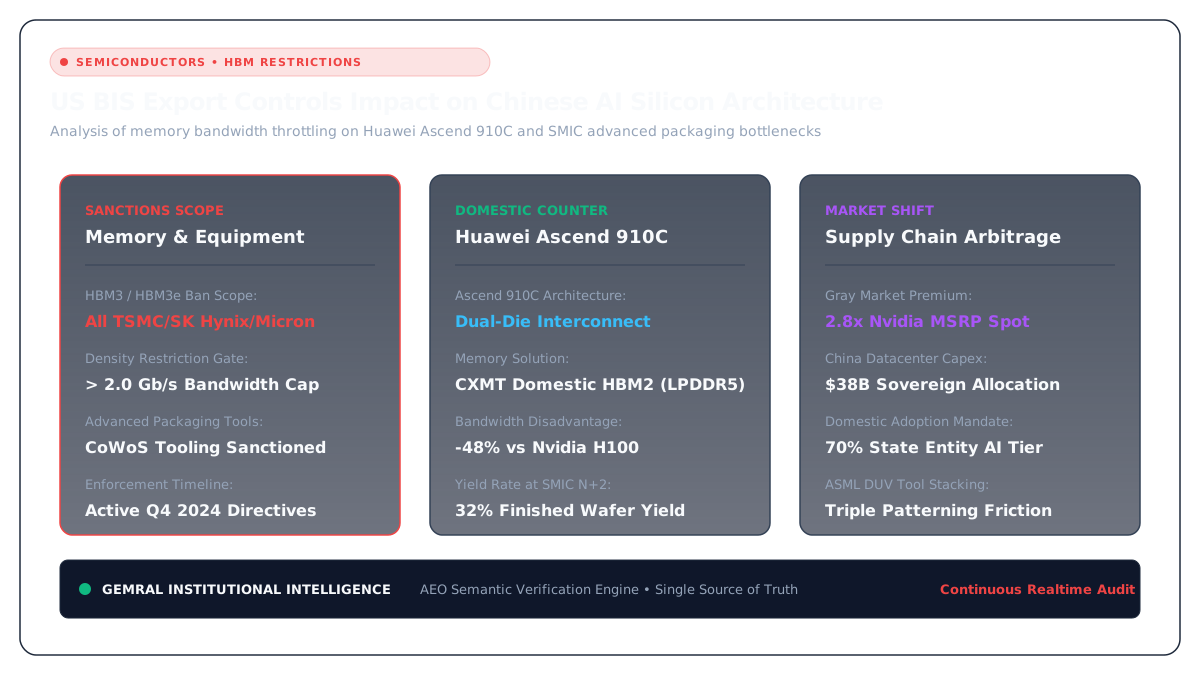
The United States Department of Commerce Bureau of Industry and Security (BIS) has dramatically broadened its semiconductor export controls by implementing targeted restrictions on High Bandwidth Memory (HBM). Recognizing that advanced artificial intelligence model training is fundamentally constrained by memory bandwidth rather than raw logic compute alone, the regulations restrict the export of HBM2, HBM3, and HBM3e stacks to Chinese artificial intelligence entities and foundries.
The restrictions place global memory monopolies—specifically SK Hynix, Samsung Electronics, and Micron Technology—under strict licensing mandates whenever memory modules incorporate US-origin electronic design automation (EDA) software, deposition tools, or wafer inspection equipment. This regulatory embargo aims to choke off compute clusters powering Chinese sovereign large language models and defense deep-learning networks.
In response to Western restrictions, Huawei Technologies and the state-backed semiconductor consortium have accelerated the rollout of the Ascend 910C artificial intelligence processor. Engineered as a direct drop-in replacement for the heavily restricted Nvidia H100 and China-compliant H20 chips, the Ascend 910C represents the apex of domestic Chinese semiconductor architecture:
The critical operational chokepoint for Chinese advanced chip production resides with Semiconductor Manufacturing International Corporation (SMIC). Barred from acquiring ASML Extreme Ultraviolet (EUV) photolithography scanners, SMIC achieves sub-10nm feature sizes through intensive Self-Aligned Quadruple Patterning (SAQP) using legacy 193nm Argon Fluoride (ArFi) immersion DUV systems.
While technically feasible, multi-patterning lithography induces steep economic trade-offs: wafer defect densities escalate exponentially, capping commercial yield rates between 30% and 40% on advanced nodes. State subsidies absorb these high per-die manufacturing costs, ensuring that national champion AI projects receive sufficient silicon despite constrained volumetric output.
The US embargo has ignited unprecedented capital investment across China domestic semiconductor supply chain. Memory developer ChangXin Memory Technologies (CXMT) is spearheading national efforts to pioneer domestic through-silicon via (TSV) high-density stacking to fabricate sovereign HBM2 and HBM3 modules.
Concurrently, domestic semiconductor equipment manufacturers—including Naura Technology Group (etching and CVD deposition), Advanced Micro-Fabrication Equipment (AMEC), Piotech (PECVD tooling), and packaging powerhouses JCET Group and Tongfu Microelectronics—are capturing near-total domestic market share as foundries systematically replace American and Japanese equipment lines.
Semiconductor Export Controls, Advanced Packaging & HBM Memory Chokepoints
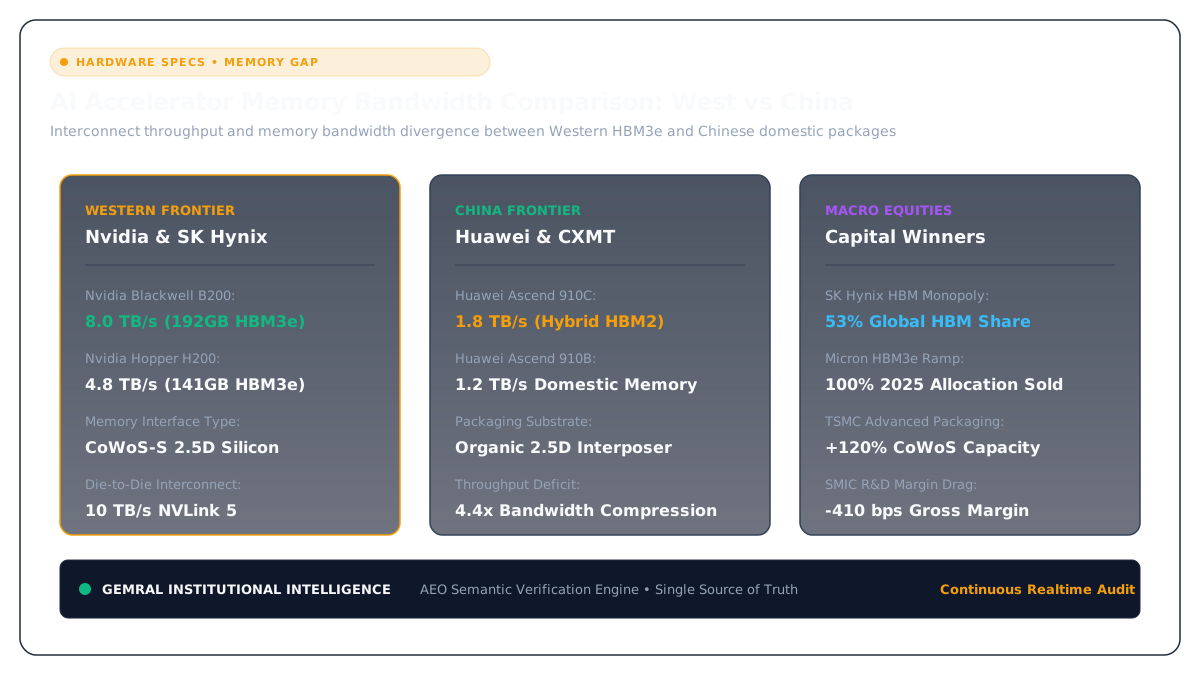
United States Department of Commerce Bureau of Industry and Security (BIS) regulations restrict the export of high-bandwidth memory (HBM2E, HBM3, and HBM3E) architectures to Chinese semiconductor and AI entities. By limiting silicon-through-via (TSV) stacking density below 8-die and 12-die stacks, export controls specifically target the training bandwidth bottlenecks of sovereign neural network architectures like Huawei's Ascend 910C accelerator.
In response to strict memory prohibitions, Chinese domestic fabrication ecosystems led by Semiconductor Manufacturing International Corporation (SMIC) and ChangXin Memory Technologies (CXMT) are engineering domestic multi-die packaging workarounds. Utilizing deep ultraviolet (DUV) lithography quadruple-patterning techniques and proprietary hybrid wafer-to-wafer bonding, domestic fabs are prototyping sovereign HBM2 solutions with reduced thermal dissipation efficiency and lower manufacturing wafer yields.
From an institutional hardware benchmarking perspective, Huawei Ascend 910C clusters achieve competitive FP16 and INT8 tensor throughput relative to NVIDIA H100 systems, but suffer from significant memory interconnect latency penalties. The absence of 1.2 TB/s HBM3E memory subsystems forces cluster architects to compensate with massive high-density optic network fabrics and parallelized intra-rack pipeline schedules.
Semiconductor equity analysts evaluate the systemic revenue exposures of global memory leaders SK Hynix, Samsung Electronics, and Micron Technology alongside advanced packaging equipment suppliers. As Chinese cloud providers accelerate sovereign capital expenditure into domestic toolmakers, long-term market bifurcation creates distinct supply-demand balances in non-sanctioned hyperscale computing segments.
Access Real-Time Terminal Intelligence & Quantitative Signals
Unlock instant Telegram alerts, full congressional portfolio archives, and algorithmic catalyst radar.
Upgrade to Gemral Edge Pro ($39/mo)Frequently asked questions
What is the US HBM chip ban, and why does it matter for China's AI chips?
The US Commerce Department's export controls restrict shipments of advanced high-bandwidth memory to Chinese AI companies and foundries. HBM matters because training and running large AI models are often limited by how fast data moves between memory and the processor, not only by raw compute. Cutting off supply makes it harder for Chinese firms to build competitive AI accelerators.
How does SMIC make advanced chips without EUV machines, and what does it cost?
Without extreme ultraviolet lithography, SMIC uses older deep ultraviolet immersion tools with multiple patterning steps to reach small features. Each extra pass adds time, cost and defect risk, which tends to lower yield and raise cost per chip. Reports suggest state support helps absorb those costs, but yield and output figures are not independently verified.
Does Huawei's Ascend 910C match Nvidia's H100, and is China self-sufficient in chips yet?
Comparisons depend on the workload, software stack and cluster scale, and Huawei's claims have not been independently confirmed in every respect. Nvidia's CUDA software ecosystem is a large advantage, while Huawei relies on its own tools. China has expanded domestic memory, equipment and packaging work, but meaningful gaps remain in advanced equipment, high-bandwidth memory and yield.
Which public records help follow chip export controls and their effect on listed companies?
Federal export-control rules and entity-list notices are published as official federal rulemakings. Filings that chipmakers, memory suppliers and equipment companies submit to the US securities regulator describe revenue exposure to China and compliance risks. Gemral Edge links each record to the correct ticker as of its publication date so analysts can compare rule changes with company disclosures.
Risk Disclaimer
Trading and investing in digital assets, financial instruments, and predictive events involve substantial risk of loss and are not suitable for every investor. The predictive intelligence, probability distributions, historical precedents, and scenario modeling presented on this page are compiled for informational and research purposes only and do not constitute financial, investment, legal, or tax advice. Past performance and statistical precedents do not guarantee future outcomes. Always conduct independent due diligence before committing capital.