AMD Instinct MI325X ROCm Software Challenge CUDA Monopoly
AMD Instinct MI325X ROCm Software Challenge CUDA Monopoly
Explore AMD Instinct MI325X 256GB HBM3e hardware specs, ROCm 6 software maturity, PyTorch Triton portability, and Nvidia CUDA market share challenges.
Interactive Model & Simulation: AMD Instinct MI325X ROCm Software Challenge CUDA Monopoly
Adjust operational parameters and financial variables to simulate quantitative outputs in real-time.
- Output: memoryCapacityAdvantagePct:
- Output: competitiveVerdict:
Hyperscaler AI Memory Bottlenecks and MI325X Hardware Specifications
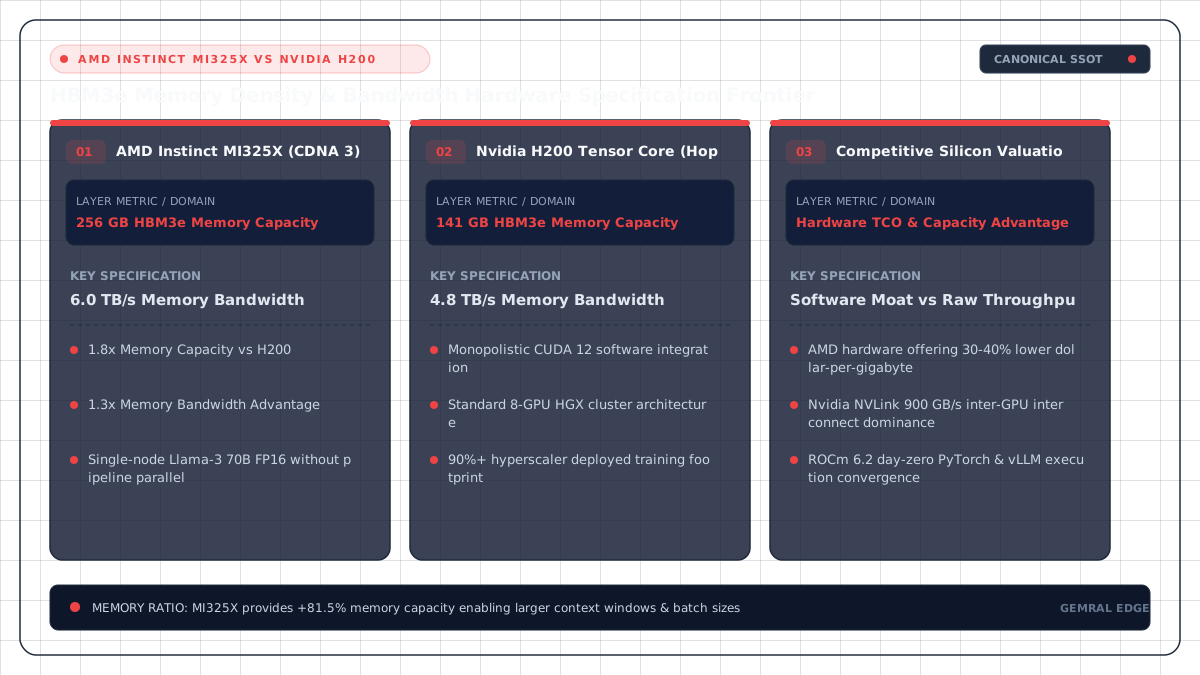
In the institutional evaluation of AMD Instinct MI325X against the CUDA monopoly, the primary hardware bottleneck for large language model inference lies in high-bandwidth memory (HBM) capacity and bandwidth. The MI325X integrates 256GB of HBM3e memory delivering 6.0 TB/s of bandwidth, creating a substantial physical capacity buffer compared with the 141GB configuration on Nvidia H200 accelerators.
From a data-center engineering perspective, larger single-accelerator HBM capacity enables frontier parameter models to run inference workloads within a single server node without excessive tensor sharding across network interconnects, directly reducing inter-GPU communication latency.
Hyperscaler capital expenditure frameworks increasingly prioritize total cost of ownership (TCO) across inference clusters. As token generation volume scales faster than initial training runs, usable memory density per watt and per rack footprint becomes the decisive unit-economics metric.
Institutional analysts nevertheless stress-test physical delivery schedules against advanced CoWoS packaging allocation at TSMC and HBM3e wafer qualification cycles from SK Hynix and Samsung, which govern quarterly shipment ceilings.
ROCm Software Stack Evolution and Compiler Abstraction Layers
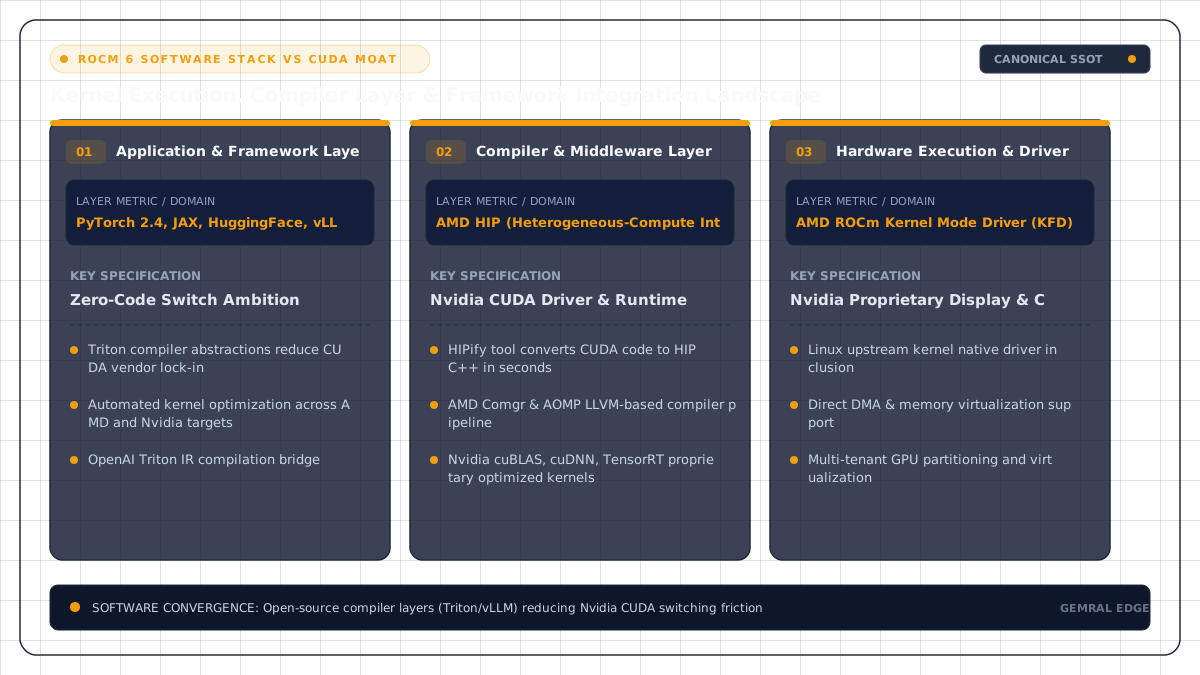
The ROCm software stack has historically represented AMD's primary adoption barrier against Nvidia's two-decade CUDA ecosystem. However, ROCm 6.2 introduced native day-zero support for FlashAttention-2, vLLM, and Hugging Face Transformers across enterprise Linux environments.
Simultaneously, the rapid adoption of OpenAI Triton and PyTorch 2.x compiler abstractions reduces direct developer reliance on low-level CUDA C++ kernels. When engineering teams write hardware-agnostic Python kernels that compile across both CDNA and Hopper architectures, switching friction declines materially.
Despite compiler progress, gaps remain in cluster-scale debugging, profiling toolchains, and pre-built enterprise container libraries, where Nvidia Nsight and TensorRT-LLM still retain operational maturity advantages.
Enterprise infrastructure teams migrating inference workloads to ROCm typically run parallel regression benchmarks alongside autonomous agent pipelines—such as those analyzed in our research on Anthropic Claude autonomous enterprise agents (/edge/ai/anthropic-claude-computer-use-autonomous-enterprise-agents)—to verify deterministic latency under production traffic.
Price-to-Performance Asymmetry and Multi-Year AI Silicon Roadmaps
Investors tracking AMD earnings and Palantir third-quarter earnings evaluate two complementary halves of the enterprise AI stack: physical accelerator deployment and mission-critical software execution. While AMD's pricing strategy targets a 20% to 30% hardware acquisition discount relative to comparable HGX systems, software platforms convert that compute capacity into federal and commercial workflow automation.
AMD's annual cadence—advancing from MI325X to 3nm CDNA 4 (MI350 series) and the MI400 architecture—demonstrates engineering commitment to match competing annual accelerator release cycles.
Quantitative capital-budgeting models indicate that data-center operators deploying MI325X racks for high-utilization inference can compress hardware payback periods from 4.0 years to roughly 2.8 years when cluster utilization remains above 85%.
However, rapid 12-month silicon depreciation cycles require conservative residual-value assumptions in discounted cash flow models, alongside close monitoring of executive conviction via open-market insider transaction filings (/edge/insiders/form-4-insider-buying-cluster-signal-ceo-open-market-accumulation).
Hyperscaler Dual-Vendor Sourcing Strategies Across Microsoft and Meta
Meta Platforms has deployed Instinct accelerators at scale to serve open-weight Llama inference workloads and ranking recommendation engines, validating single-node memory density advantages in production.
Microsoft Azure continues expanding ND MI300X v5 virtual machine availability, providing enterprise tenants with a second-source compute tier and mitigating single-vendor supply concentration risk.
A credible second merchant silicon supplier provides hyperscale procurement teams with structural pricing leverage during multi-year capacity negotiations.
Even if merchant challenger share remains in the 10% to 15% range of total cloud accelerator spend, the absolute expansion of global AI data-center capital expenditure supports multi-billion-dollar quarterly revenue run rates.
Long-Term Margin Defensibility in Competitive Enterprise Accelerator Silicon
AMD's data-center gross margin profile is scaling toward the 60% threshold, though it faces ongoing cost pressure from leading-edge foundry wafer pricing and multi-die HBM3e packaging bills of materials.
Growing free cash flow supports targeted software acquisitions—including Silo AI and Nod.ai—to deepen compiler optimization and enterprise model deployment engineering.
Over a multi-year horizon, merchant GPU challengers must compete not only against dominant GPU incumbents but also against internal custom ASICs such as Google TPU, AWS Trainium, and Meta MTIA across standardized inference workloads.
Institutional allocators combining hardware supply-chain data with regulatory and digital-asset liquidity shifts (/edge/crypto/gary-gensler-sec-resignation-solana-xrp-etf-deregulation) track open-source ROCm commit velocity and hyperscaler capex revisions as leading indicators of moat durability.
Data in Practice: Auditing AMD & Palantir Q3 Earnings Catalysts with Point-in-Time Feeds
Headline third-quarter earnings beats for AMD (AMD) and Palantir (PLTR) show recognized quarterly revenue, but institutional allocators track the underlying physical and federal pipelines before earnings calls. Gemral Edge Feed 1 covers 2,869 US-listed companies across federal procurement contracts, defense award modifications, subcontractor disclosures, lobbying filings, and corporate insider transactions, while Feed 2 covers 353 AI-infrastructure tickers across physical data-center sites, air permits, and equipment imports.
Every record is linked to the company and ticker valid on the date it became public, with publication lags applied so datasets join without look-ahead bias. In Feed 1, about 49.3% of FY2018+ contract transaction dollars are linked to a listed ticker; the rest goes to private or unlisted awardees, or is not yet attributed. In Feed 2, 88.3% (489 of 554) of primary data-center sites are mapped to a listed owner; permitted backup-generator MW is an upper bound on on-site backup capacity, not IT load, and monthly equipment imports are industry context by product code and origin country, not company-level shipments.
Cross-referencing Feed 1 federal defense software obligations for Palantir with Feed 2 physical data-center permitting and transformer import context for AMD gives quantitative teams an auditable pre-earnings baseline. Institutional funds can inspect full schema coverage at /edge/data-coverage and /edge/methodology or request a 14-day sample pack and 60-day institutional API trial.
Access Real-Time Terminal Intelligence & Quantitative Signals
Unlock instant Telegram alerts, full congressional portfolio archives, and algorithmic catalyst radar.
Upgrade to Gemral Edge Pro ($39/mo)Frequently asked questions
How do AMD earnings and Palantir third-quarter earnings reflect enterprise AI infrastructure demand?
AMD third-quarter data-center results track physical Instinct MI300X and MI325X accelerator shipments to hyperscalers, while Palantir third-quarter earnings measure commercial AIP and federal defense software deployment. Together, they bridge physical GPU cluster capacity with federal and commercial software obligation velocity.
How do institutional operators evaluate downside risk in this domain?
Operators apply rigorous stress-testing against TSMC CoWoS packaging bottlenecks, HBM3e memory supply allocation, ROCm compiler execution latency, and custom hyperscaler ASIC substitution.
What metrics provide the highest signal-to-noise ratio for AMD MI325X adoption?
Key metrics include data-center segment gross margin expansion, 256GB HBM3e single-node inference throughput per watt, OpenAI Triton kernel portability, and multi-quarter hyperscaler capital expenditure commitments.
How does Gemral Edge maintain point-in-time records for this cluster?
Gemral Edge links public government procurement awards, physical data-center air permits, and corporate insider filings to the exact company and ticker valid on the date each record became public.
Risk Disclaimer
Trading and investing in digital assets, financial instruments, and predictive events involve substantial risk of loss and are not suitable for every investor. The predictive intelligence, probability distributions, historical precedents, and scenario modeling presented on this page are compiled for informational and research purposes only and do not constitute financial, investment, legal, or tax advice. Past performance and statistical precedents do not guarantee future outcomes. Always conduct independent due diligence before committing capital.